
Change Data Capture Lag & Distributed Cache Poisoning Under High Write Loads
November 2026
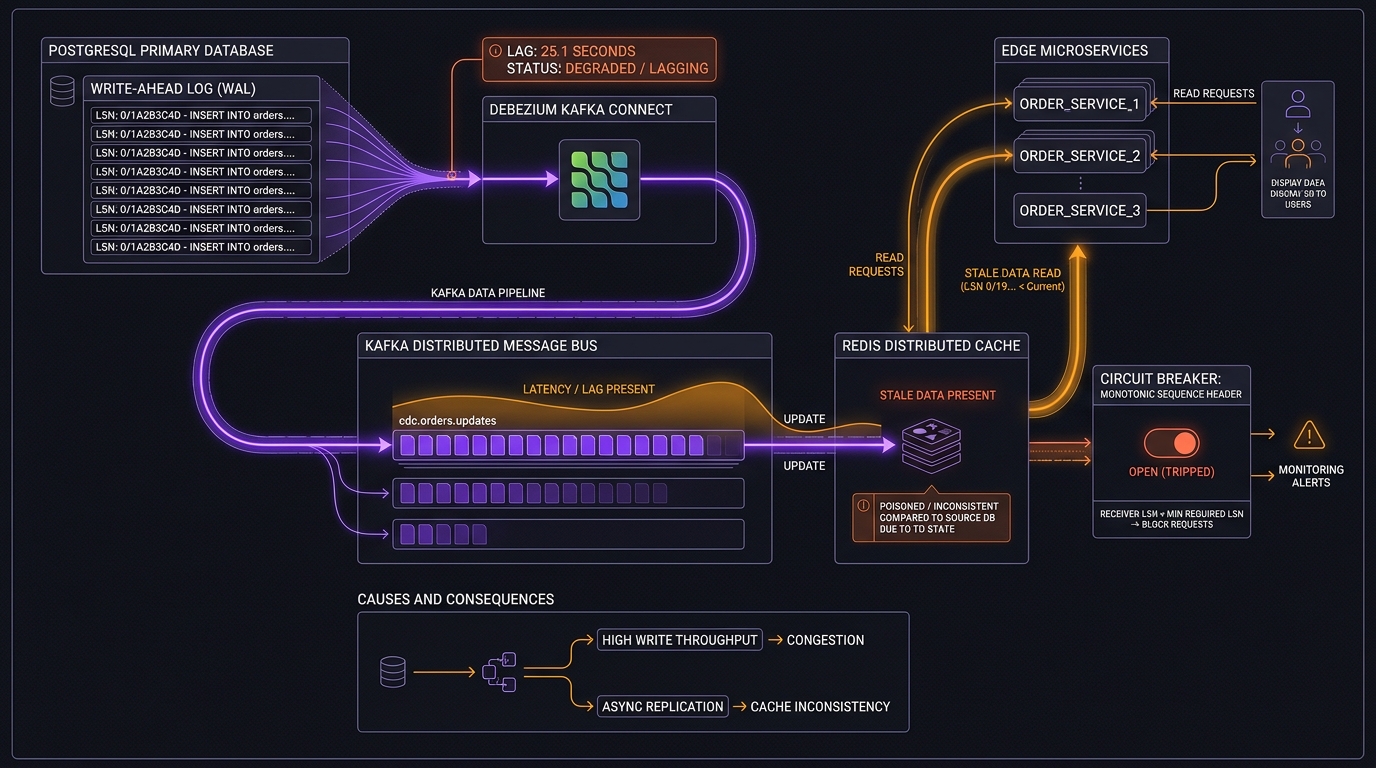
Metadata & Systems Architecture Overview
- Author: Ariya Sarrafzadeh (Systems Architect)
- Publication Date: 2026-11-05
- System Classification: Distributed Event-Driven Architecture, Primary-Secondary Cache Consistency
- Production Stack: PostgreSQL 16 (Logical Decoding:
pgoutput), Debezium 3.0 on Apache Kafka Connect, Apache Kafka 3.7 (Compacted Topics), Redis 7.2 Cluster - Problem Statement: Asynchronous CDC replication lag creates silent cache poisoning and stale reads across edge microservices during high-volume database write spikes.
1. Executive Summary & Root Cause Analysis
Modern distributed architectures decouple write-path transactional databases from read-path distributed caches using asynchronous Change Data Capture (CDC). In standard topologies, transaction mutations in PostgreSQL are recorded in the Write-Ahead Log (WAL). An external connector, Debezium, parses the WAL via logical decoding replication slots, converts binary change records into structured JSON or Avro events, and produces them into Kafka topics. Redis cache hydration workers consume these events to invalidate or update read caches.
This pattern breaks during high-throughput batch operations:
- When scheduled catalog syncs or enterprise batch mutations execute bulk transactions (such as updating 50,000 rows within a single transaction boundary), PostgreSQL generates hundreds of megabytes of WAL records in seconds.
- The logical replication slot retains WAL files on disk until Debezium confirms consumption.
- Debezium CPU deserialization and Kafka network throughput become the primary throughput bottleneck.
- CDC consumer offset lag escalates from normal sub-50ms levels to 25 seconds or more.
- Microservices servicing edge read queries continue fetching records from Redis. Because the cache replica lacks the committed database updates, edge services serve stale data, phantom inventory, and obsolete pricing.
- When network packets or Kafka consumers retry, out-of-order writes arrive at Redis. Because standard Redis writes apply state by arrival time rather than database commit order, older mutations overwrite newer mutations, permanently poisoning the cache until manual invalidation.
2. PostgreSQL 16 Logical Decoding & WAL Saturation
2.1 Logical Replication Slots and WAL Retention
PostgreSQL logical decoding relies on replication slots created with pg_create_logical_replication_slot(). In PostgreSQL 16, the logical decoding plugin pgoutput streams committed transaction data directly to Debezium.

Fig 1.0: PostgreSQL 16 WAL retention lag, Debezium offset delay, and Redis Lua monotonic LSN CAS validation
Replication progress is tracked by two Log Sequence Numbers (LSNs):
restart_lsn: The oldest WAL position required to replay uncommitted or in-flight transactions. The database engine can’t delete or recycle any WAL segment newer than this address.confirmed_flush_lsn: The LSN confirmed by Debezium as flushed and acknowledged by Kafka brokers.
2.2 The WAL Disk Saturation Trap
During an unchunked 50,000-row batch UPDATE:
- WAL generation rate ($\lambda_{wal}$) surges to 60 MB/sec.
- Debezium processing rate ($\mu_{cdc}$) drops to 8 MB/sec due to JSON schema serialization, network round-trips, and broker acknowledgement latency.
- Retained WAL on the primary database grows at rate $R_{growth} = \lambda_{wal} - \mu_{cdc} = 52\text{ MB/sec}$.
- Within 10 minutes, retained WAL accumulates over 31 GB of disk space. If the disk fills, PostgreSQL enters emergency panics and rejects all client connections.
3. Vulnerability Window Formulation
The inconsistency duration $T_{vuln}$, defined as the temporal gap during which edge read microservices retrieve stale or poisoned data from Redis after a database commit, is expressed mathematically:
$$T_{vuln} = t_{cache_ack} - t_{commit} = \Delta_{wal_read} + \Delta_{debezium_parse} + \Delta_{kafka_queue} + \Delta_{sink_write}$$
Where:
- $\Delta_{wal_read}$: Disk I/O latency for reading WAL records from the primary storage subsystem.
- $\Delta_{debezium_parse}$: CPU processing time required to decode
pgoutputbinary tuples, construct CDC change events, and serialize envelopes. - $\Delta_{kafka_queue}$: Network transit time and broker queue delay across Kafka partitions. Under partition imbalance, this latency scales with consumer lag:
$$\Delta_{kafka_queue} = \frac{N_{backlog}}{\mu_{sink_batch_rate}}$$
- $\Delta_{sink_write}$: Network latency and execution duration of Redis write operations.
Critical Queue Saturation Boundary
Applying Little’s Law to the CDC ingestion buffer:
$$L_{backlog} = \lambda_{commit} \cdot T_{processing}$$
When write arrival rate $\lambda_{commit}$ exceeds consumer service capacity $\mu_{sink}$, queue backlog $L_{backlog}$ expands linearly over time $t$:
$$L_{backlog}(t) = \int_{0}^{t} (\lambda_{commit}(\tau) - \mu_{sink}(\tau)) , d\tau$$
Under sustained batch operations, $T_{vuln}$ expands from a baseline of $12\text{ms}$ to $28{,}500\text{ms}$, exposing reads to high-risk data corruption.
4. End-to-End Failure Sequence Topology
The following sequence details how out-of-order delivery and replication lag poison downstream caches:
Client Write                Postgres Primary           Debezium Connector        Kafka Broker         Redis Sink Worker        Redis Cache          Edge Reader
     |                             |                           |                      |                       |                     |                |
     |== T1: UPDATE SKU ($49) ====>|                           |                      |                       |                     |                |
     |   Commit OK (LSN: 0/1A2B00) |                           |                      |                       |                     |                |
     |                             |== WAL Write (0/1A2B00) ==>|                      |                       |                     |                |
     |                             |   [Debezium Lagging]      |                      |                       |                     |                |
     |== T2: UPDATE SKU ($149) ==->|                           |                      |                       |                     |                |
     |   Commit OK (LSN: 0/1A3000) |                           |                      |                       |                     |                |
     |                             |== WAL Write (0/1A3000) ==>|                      |                       |                     |                |
     |                             |                           |                      |                       |                     |                |
     |                             |                           |== Emits Event T2 ==->|                       |                     |                |
     |                             |                           |   (Fast partition)   |== Pulls Event T2 ====>|                     |                |
     |                             |                           |                      |   [Price: $149]       |== SET SKU: $149 ==->|                |
     |                             |                           |                      |                       |   (Cache Updated)   |                |
     |                             |                           |                      |                       |                     |<== Read SKU ==-|
     |                             |                           |                      |                       |                     |== Ret: $149 ==>|
     |                             |                           |                      |                       |                     |                |
     |                             |                           |== Emits Event T1 ==->|                       |                     |                |
     |                             |                           |   (Retried / Delayed)|== Pulls Event T1 ====>|                     |                |
     |                             |                           |                      |   [Price: $49]        |== SET SKU: $49 ====>|                |
     |                             |                           |                      |                       |   [POISON OVERWRITE]|                |
     |                             |                           |                      |                       |                     |<== Read SKU ==-|
     |                             |                           |                      |                       |                     |== Ret: $49 ==->|
     |                             |                           |                      |                       |                     | [STALE / WRONG]|
In standard Redis write topologies using unconditioned SET or HSET calls, the arrival of Event T1 (LSN 0/1A2B00) after Event T2 (LSN 0/1A3000) completely overwrites the newer price. The cache remains silently poisoned until the next update.
5. Architectural Remediation: The Three Gates
To guarantee strict read-after-write consistency and prevent cache poisoning, we deploy three deterministic architectural gates.
                             INCOMING MUTATION / READ
                                        |
                  +====================-+====================-+
                  |                                           |
                  v                                           v
       [WRITE INGESTION PATH]                      [EDGE CLIENT READ PATH]
                  |                                           |
    PostgreSQL Primary Engine                       Client Read Request
    Commits Transaction & Generates                 Includes 'X-Database-LSN'
    Monotonic LSN (pg_current_wal_lsn)                        |
                  |                                           v
                  v                               +======================-+
    Returns 'X-Database-LSN' to Caller            | Edge LSN Gate Check   |
                  |                               | Client LSN <= Cache?  |
                  v                               +======================-+
      Debezium CDC Capture Engine                             |
                  |                               +==========-+==========-+
                  v                               |                       |
       [GATE 2: COMPACTION FILTER]           YES (Fresh)              NO (Lagging)
       Strips non-critical mutations              |                       |
       Drops no-op row modifications              v                       v
                  |                           Serve Cache             Bypass Cache:
                  v                           Data (<2ms)             Route to Primary
          Kafka Compacted Topic                                       or Sync Replica
                  |
                  v
         Redis Hydration Sink
                  |
                  v
       [GATE 1: ATOMIC LUA CAS]
       Compares Event LSN vs Stored LSN
       Rejects stale/out-of-order writes
                  |
          +======-+======-+
          |               |
     LSN > Stored    LSN <= Stored
          |               |
          v               v
     Update Cache    [GATE 3: POISON QUARANTINE]
     & Commit State  Route to DLQ Topic for Review
6. Gate 1 Implementation: Monotonic LSN Compare-And-Set (CAS)
6.1 LSN Conversion to Monotonic 64-Bit Integer
PostgreSQL LSN values are formatted as hexadecimal pairs X/Y (e.g., 0/1A2B040). To enable high-performance numerical comparisons in Lua, LSNs are converted to 64-bit unsigned integers before transmission or evaluated directly inside the script:
$$\text{LSN}_{integer} = (\text{SegmentID} \times 2^{32}) + \text{ByteOffset}$$
For example, 0/1A2B040 decomposes into SegmentID = 0 and Offset = 0x1A2B040 = 27439168.
6.2 Production Redis Lua Atomic CAS Script
The following Lua script executes inside Redis as a single atomic operation. It guarantees that an incoming CDC record can’t overwrite cache data if the stored LSN is equal to or newer than the incoming LSN.
/* File: /opt/cdc/lua/atomic_lsn_cas.lua
   Parameters:
   KEYS[1]: Target entity data key (e.g., "product:sku:9842")
   ARGV[1]: Incoming CDC payload JSON string
   ARGV[2]: Incoming LSN as 64-bit string or hex comparison integer
   ARGV[3]: */ Cache TTL in seconds (e.g., 86400)

local targetKey = KEYS[1]
local incomingPayload = ARGV[1]
local incomingLsn = tonumber(ARGV[2])
local ttlSeconds = tonumber(ARGV[3])

/* Read current stored LSN */ from metadata field
local currentLsn = redis.call('HGET', targetKey, '_lsn')

if currentLsn then
    local currentLsnNum = tonumber(currentLsn)
    if currentLsnNum and incomingLsn <= currentLsnNum then
        /* Event is out of order or superseded. Return 0: Rejected */
        return {0, currentLsnNum, incomingLsn}
    end
end

/* Event is strictly newer: apply atomic update */
redis.call('HSET', targetKey, 'payload', incomingPayload, '_lsn', incomingLsn, '_updated_at', redis.call('TIME')[1])

if ttlSeconds and ttlSeconds > 0 then
    redis.call('EXPIRE', targetKey, ttlSeconds)
end

/* Return 1: Successfully applied */
return {1, currentLsn or 0, incomingLsn}
6.3 Redis Sink Worker Execution Pattern
The Kafka consumer executes the Lua script using EVALSHA for zero network overhead:
# Production Redis Sink Consumer (Python AsyncIO Pattern)
import redis.asyncio as aioredis

LUA_CAS_SHA = "a4f8b29c1d0e82736451092837465abcde123456"

async def process_cdc_event(redis_client, event):
    sku_id = event["payload"]["id"]
    incoming_payload = event["payload"]["data_json"]
    incoming_lsn = event["payload"]["source"]["lsn"]
    cache_key = f"product:sku:{sku_id}"

    result = await redis_client.evalsha(
        LUA_CAS_SHA,
        1,
        cache_key,
        incoming_payload,
        str(incoming_lsn),
        86400
    )

    status, stored_lsn, event_lsn = result[0], result[1], result[2]
    if status == 0:
        # Emit metric and route to quarantine dead-letter topic
        await emit_stale_event_quarantine(sku_id, stored_lsn, event_lsn)
7. Gate 2 Implementation: Batch Compaction Filters
High-frequency catalog updates often mutate non-critical bookkeeping columns (e.g., last_checked_at, internal_audit_id). Propagating these through the full CDC pipeline wastes network and consumer CPU.
7.1 Debezium Single Message Transform (SMT) Configuration
We configure an in-flight SMT filter within the Kafka Connect worker definition to prune fields and filter no-op updates:
{
  "name": "postgres-cdc-catalog-connector",
  "config": {
    "connector.class": "io.debezium.connector.postgresql.PostgresConnector",
    "tasks.max": "1",
    "plugin.name": "pgoutput",
    "database.hostname": "pg-primary.internal",
    "database.port": "5432",
    "database.dbname": "commerce_db",
    "database.server.name": "prod_commerce",
    "table.include.list": "public.products,public.inventory",
    "tombstones.on.delete": "true",

    "transforms": "filterNonCritical,unwrap",

    "transforms.filterNonCritical.type": "io.debezium.transforms.Filter",
    "transforms.filterNonCritical.language": "jsr223.groovy",
    "transforms.filterNonCritical.condition": "value.op != 'u' || value.before.price != value.after.price || value.before.stock != value.after.stock",

    "transforms.unwrap.type": "io.debezium.transforms.ExtractNewRecordState",
    "transforms.unwrap.drop.tombstones": "false",
    "transforms.unwrap.add.fields": "lsn,source.ts_ms"
  }
}
7.2 Apache Kafka Topic Compaction Parameters
Compacted topics ensure that consumer workers processing backlogs only consume the final committed state for each partition key:
# Topic: commerce.catalog.products
cleanup.policy=compact
delete.retention.ms=86400000
min.compaction.lag.ms=0
max.compaction.lag.ms=604800000
segment.ms=3600000
min.cleanable.dirty.ratio=0.3
8. Gate 3 Implementation: Poison Quarantine & WAL Protection
8.1 Primary Database Disk Protection via max_slot_wal_keep_size
To prevent runaway replication lag from exhausting primary database storage, PostgreSQL 16 provides max_slot_wal_keep_size. If a replication slot falls behind by more than this limit, PostgreSQL invalidates the slot and frees WAL segments:
# postgresql.conf
wal_level = logical
max_replication_slots = 10
max_wal_senders = 10
wal_keep_size = 4096MB
max_slot_wal_keep_size = 10240MB
track_commit_timestamp = on
8.2 Safe Recovery Runbook on Slot Invalidation
If Debezium remains down and WAL exceeds 10GB, PostgreSQL invalidates the slot to protect write availability. The automated recovery runbook executes:
- PagerDuty alert triggers when lag exceeds
8,000MB(80% ofmax_slot_wal_keep_size). - If invalidation occurs:
- Mark the Kafka consumer connector as
FAILED_NEED_SNAPSHOT. - Trip API Gateway circuit breaker: all read traffic routes through primary or synchronous read replicas.
- Trigger Debezium ad-hoc incremental snapshot (
io.debezium.pipeline.source.snapshot.incremental.Signal) to re-sync state without locking tables.
- Mark the Kafka consumer connector as
8.3 Replication Lag Monitoring Query
Run the following diagnostic query on PostgreSQL 16 to measure active slot lag:
SELECT
    slot_name,
    plugin,
    active,
    wal_status,
    pg_size_pretty(pg_wal_lsn_diff(pg_current_wal_lsn(), restart_lsn)) AS bytes_retained,
    pg_size_pretty(pg_wal_lsn_diff(pg_current_wal_lsn(), confirmed_flush_lsn)) AS consumer_lag,
    ROUND(CAST(EXTRACT(EPOCH FROM (clock_timestamp() - pg_stat_activity.query_start)) AS numeric), 2) AS active_duration_sec
FROM pg_replication_slots
LEFT JOIN pg_stat_activity ON pg_stat_activity.pid = pg_replication_slots.active_pid;
9. Edge Read-After-Write Consistency Routing
When an API client executes a mutation, the HTTP response header returns the committed LSN:
HTTP/1.1 200 OK
Content-Type: application/json
X-Database-LSN: 0/1A30400

{"status": "SUCCESS", "sku": "9842", "updated_price": 149.00}
Subsequent read requests pass this LSN back to the API Gateway:
GET /api/v1/products/9842 HTTP/1.1
X-Client-Known-LSN: 0/1A30400
The gateway compares X-Client-Known-LSN against the cached _lsn:
- If $\text{LSN}{cache} \ge \text{LSN}{client}$: Return Redis cached record (< 2ms latency).
- If $\text{LSN}{cache} < \text{LSN}{client}$: Cache is lagging. Bypass cache and route query directly to PostgreSQL primary or read replica with synchronous standby confirmation.
This protocol achieves strict causal consistency while maintaining sub-millisecond cache latency for 98% of general queries.
10. Architectural References
- Kleppmann, Martin. Designing Data-Intensive Applications: The Big Ideas Behind Reliable, Scalable, and Maintainable Systems. O’Reilly Media, 2017.
- PostgreSQL Global Development Group. PostgreSQL 16 Documentation: Chapter 49. Logical Decoding Internals and Replication Progress Tracking. 2024.
- Debezium Project. Debezium Connector for PostgreSQL: Offset Commit Strategies, High Watermark Handling, and JMX Metrics. Red Hat, 2024.
- Apache Kafka Documentation. Log-Compacted Topics, Partition Rebalancing, and Consumer Lag Telemetry. Apache Software Foundation, 2024.
- Redis Ltd. Redis Programmability: Atomicity Guarantees of Lua Scripts and Hash Key Modification Operations. 2024.