
The ISO 20022 Truncation Trap: Remittance Data Loss in Cross-Border Payments
November 2026
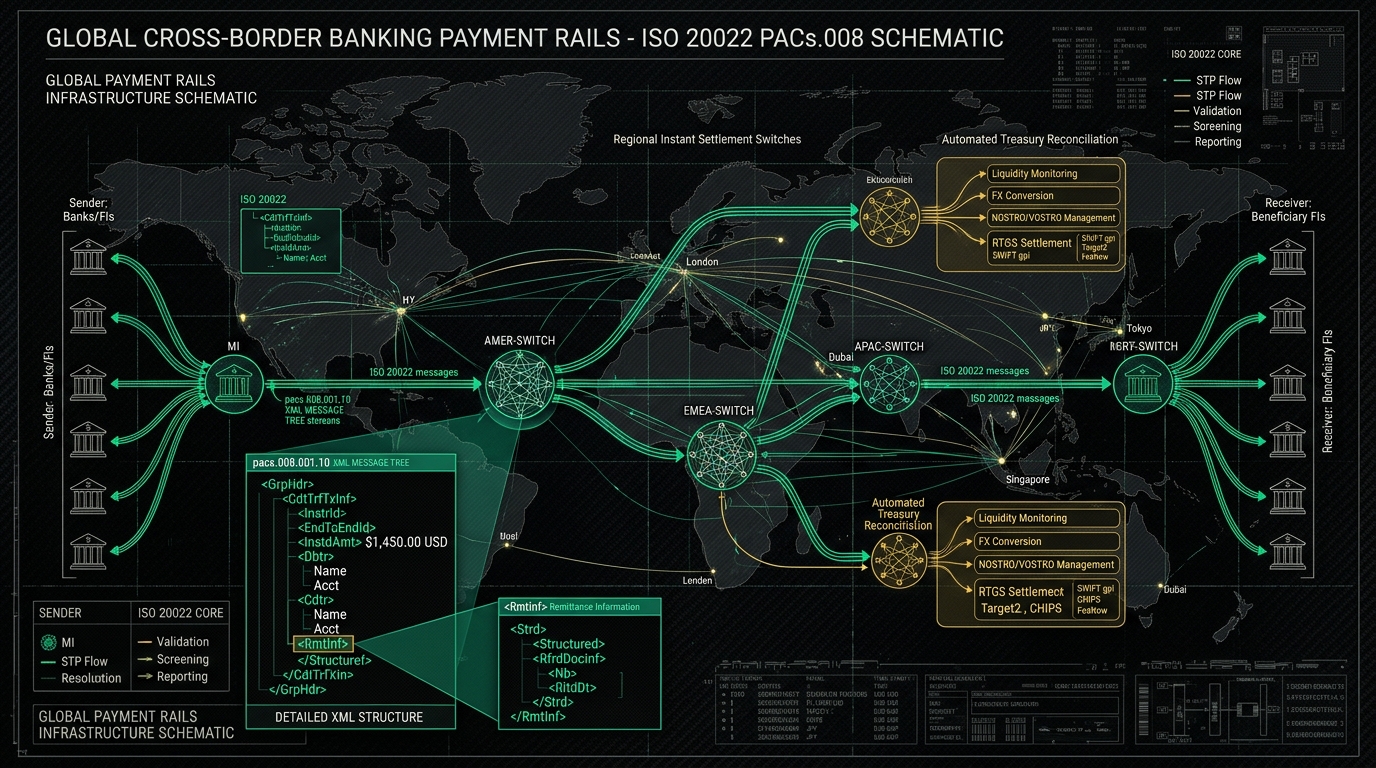
Document ID: WP-FIN-2026-001
Classification: Financial Infrastructure & Protocol Engineering
Target Systems: SWIFT CBPR+, FedNow, SEPA Instant, UAE Aani, RTGS Core Translators
Author: Ariya Sarrafzadeh | Solutions Architect & Technical Product Owner
1. Executive Summary & Problem Scope
Global payment networks are executing a multi-year migration from legacy SWIFT MT formats to rich ISO 20022 MX (XML) schemas. In our audits, we’ve found financial institutions operating in a hybrid environment where upstream originators emit ISO 20022 pacs.008.001.10 messages, but downstream correspondent nodes or regional clearing networks continue to process legacy SWIFT MT103 message frames.
This mismatch introduces an asynchronous data loss vulnerability: the silent truncation of structured remittance information at translator gateways.

Fig 1.0: pacs.008 XML hierarchy vs MT103 Field 70 truncation and deterministic SHA-256 preservation rail
When you downgrade an ISO 20022 XML tree to an MT103 message, the translator encounters the hard capacity limits of MT103 Field 70 (Remittance Information). While the XML source schema allows extensive remittance structures with arbitrary invoice lines, tax references, and creditor identifiers, MT103 Field 70 is restricted to a maximum of 4 lines of 35 characters each (140 characters total).
We’ve watched intermediate gateways silently truncate data exceeding 140 characters to prevent parser rejection and avoid broken Straight-Through Processing (STP). Your wire clears the central bank switch, your dashboard turns green, but you’ve lost the remittance references. Real-Time Gross Settlement (RTGS) switch. The funds arrive at the beneficiary bank. However, the structured invoice metadata required by enterprise resource planning (ERP) systems is stripped. The incoming credit can’t be matched automatically. Your funds get diverted into internal suspense accounts, requiring manual investigation and delaying corporate liquidity for up to 72 hours.
2. Downward Translation Architecture & SWIFT CBPR+ Specifications
The SWIFT Cross-Border Payments and Reporting Plus (CBPR+) specification governs the conversion between ISO 20022 and MT message formats.
2.1 Structural Mismatch: Hierarchical MX vs Flat MT
| Dimension | ISO 20022 pacs.008.001.10 | SWIFT MT103 |
| : - - | : - - | : - - |
| Data Model | Typed hierarchical XML schema | Flat ASCII tagged fields |
| Remittance Container | <RmtInf><Strd>...</Strd></RmtInf> | Field 70 (:70:) |
| Max Capacity | Practically unconstrained (KB range) | 4 lines x 35 characters (140 characters) |
| Character Set | UTF-8 (Extended international characters) | SWIFT X-Character Set (Strict ASCII subset) |
| Referred Document | <RfrdDocInf><Nb>...</Nb></RfrdDocInf> | Merged into unstructured text lines |
| Tax Information | <TaxRmt><RcptId>...</TaxRmt> | Dropped or truncated |
| Creditor Reference | ISO 11649 Structured Reference (<CdtrRefInf>) | Often mangled by line wrapping |
2.2 Translation RFC Mapping Algorithm
When we look at standard translation algorithms (e.g., SWIFT CBPR+ Translation Rules), the converter executes the following pseudocode:
function mapRemittance(pacs008Message):
    lines = []
    for strd in pacs008Message.CreditTransferTransactionInformation.RemittanceInformation.Structured:
        if strd.ReferredDocumentInformation exists:
            lines.append("INV/" + strd.ReferredDocumentInformation.Number)
        if strd.CreditorReferenceInformation exists:
            lines.append("REF/" + strd.CreditorReferenceInformation.Reference)
        if strd.AdditionalRemittanceInformation exists:
            for addtl in strd.AdditionalRemittanceInformation:
                lines.append("TXT/" + addtl)

    // Flatten and enforce MT103 Field 70 boundary
    flatText = join(lines, "/")
    field70Lines = splitIntoChunks(flatText, maxLineLength=35, maxLines=4)

    if flatText.length > 140:
        logWarning("Remittance data truncated: original=" + flatText.length + " bytes")
        // SILENT TRUNCATION OCCURS HERE
        return field70Lines.slice(0, 4)

    return field70Lines
Because the translation rules mandate successful transport over data preservation, the translator emits a valid MT103 payload. The messaging network considers the transaction valid. The application layer above the network loses its critical linkage.
3. Mathematical Model of Truncation & Collision Probability
3.1 Truncation Probability
Let $L$ be a random variable representing the total length of a serialized structured remittance block in characters. Let $N$ denote the number of line items or referenced documents in an invoice batch, and let $X_i$ represent the character length of the $i$-th component:
$$L = \sum_{i=1}^{N} X_i + (N - 1) C_{sep}$$
Where $C_{sep}$ is the delimiter overhead per field. Assuming $X_i$ are independent and identically distributed with mean $\mu_X$ and variance $\sigma_X^2$, and $N$ follows a discrete distribution with mean $\mu_N$ and variance $\sigma_N^2$:
$$\mathbb{E}[L] = \mu_N \mu_X + (\mu_N - 1) C_{sep}$$
$$\operatorname{Var}(L) = \mu_N \sigma_X^2 + \mu_X^2 \sigma_N^2$$
By the Central Limit Theorem for random sums, for corporate billing volumes $L$ can be approximated as normally distributed $\mathcal{N}(\mu_L, \sigma_L^2)$.
The probability of silent truncation $P_{\text{trunc}}$ across a legacy bridge is given by:
$$P_{\text{trunc}} = \mathbb{P}(L > 140) = 1 - \Phi\left(\frac{140 - \mu_L}{\sigma_L}\right) = \frac{1}{2} \operatorname{erfc}\left(\frac{140 - \mu_L}{\sigma_L \sqrt{2}}\right)$$
Where $\Phi(z)$ is the cumulative distribution function of the standard normal distribution and $\operatorname{erfc}(z)$ is the complementary error function.
In empirical corporate banking datasets where an enterprise wire contains an average of 3.2 line references ($\mu_L = 192$ characters, $\sigma_L = 38$ characters):
$$z = \frac{140 - 192}{38} = \frac{-52}{38} \approx -1.368$$
$$P_{\text{trunc}} = 1 - \Phi(-1.368) = \Phi(1.368) \approx 0.9144 \quad (91.4%)$$
Over 91% of multi-item structured corporate payment instructions suffer data truncation when mapped to MT103 Field 70.
3.2 Reference Identifier Collision Under Prefix Truncation
When an invoice identifier string $I \in \Sigma^*$ is truncated to a prefix length $k \le 140$, the entropy of the identifier collapses. If an enterprise emits $M$ payments in a billing cycle, and identifiers share a common prefix structure (e.g., INV-2026-Q1- of length $k_{prefix}$):
The effective unique characters remaining in the truncated window are $k_{eff} = \max(0, k - k_{prefix})$.
Assuming a uniform character alphabet of size $|\Sigma|$:
$$\mathbb{P}(\text{Collision} \mid k) = 1 - \prod_{j=1}^{M-1} \left(1 - \frac{j}{|\Sigma|^{k_{eff}}}\right) \approx 1 - \exp\left(-\frac{M^2}{2 |\Sigma|^{k_{eff}}}\right)$$
When $k_{eff}$ drops due to aggressive field truncation, the probability of false match collisions increases dramatically. This results in the misallocation of incoming cash to the incorrect customer account, triggering audit investigations and ledger reversals.
4. Sequence Diagrams: Failure Path vs Remediation Path
4.1 The Silent Truncation Failure Path
sequenceDiagram
    autonumber
    participant Orig as Originator ERP
    participant Gate as Outbound MX Gateway
    participant Bridge as Regional SWIFT Bridge
    participant RTGS as Central Bank RTGS
    participant BenCore as Beneficiary Core Banking
    participant Susp as Suspense Account Ledger
    participant BenERP as Beneficiary ERP

    Orig->>Gate: pacs.008.001.10 (Full Structured Remittance, 380 bytes)
    Gate->>Bridge: pacs.008 XML Message Stream
    Note over Bridge: Translator detects legacy receiver<br/>MT103 Field 70 cap: 140 chars<br/>TRUNCATE 240 bytes silently
    Bridge->>RTGS: MT103 (Truncated Remittance: 140 chars)
    RTGS->>BenCore: MT103 Funds Settle via Nostro
    Note over BenCore: Account debited and credited<br/>STP status reports SUCCESS
    BenCore->>BenERP: Ingest Remittance Data
    Note over BenERP: Parsing error: reference broken<br/>Invoice ID missing
    BenERP-->>BenCore: Reconciliation FAILED (No match)
    BenCore->>Susp: Route Principal to Suspense (Manual Hold)
    Note over Susp: Funds frozen for 24-72 hours<br/>Manual investigation required
4.2 The Remediation Path with Deterministic Hash and Verification Gates
sequenceDiagram
    autonumber
    participant Orig as Originator ERP
    participant HashEngine as Remittance Hasher
    participant Matrix as Routing Capability Matrix
    participant Gate as Production MX Gateway
    participant Switch as Instant MX Switch
    participant BenCore as Beneficiary Bank
    participant Telemetry as pacs.002 Event Stream
    participant BenERP as Beneficiary ERP

    Orig->>HashEngine: Raw Payment & Invoice Data
    HashEngine->>HashEngine: Canonicalize UTF-8 & Generate SHA-256
    HashEngine->>Gate: Inject Hash into EndToEndId (35 chars)
    Gate->>Matrix: Query Beneficiary BIC Capability

    alt Downstream is Legacy MT Core
        Matrix-->>Gate: FLAG: Non-Compliant MT Bridge
        Gate->>Gate: Quarantine Payment / Route via Direct API
        Gate-->>Orig: Status RJCT: Downstream Truncation Risk
    else Downstream is Native ISO 20022
        Matrix-->>Gate: CONFIRM: Native MX pacs.008 Support
        Gate->>Switch: pacs.008 (Full XML + Deterministic EndToEndId)
        Switch->>BenCore: Settle Instant Funds (STP)
        BenCore->>Telemetry: Emit pacs.002.001.12 (Status: ACSC)
        Telemetry->>BenERP: Real-Time Webhook with SHA-256 Hash
        BenERP->>BenERP: Match EndToEndId Hash to Pending Receivables
        Note over BenERP: Instant Zero-Touch Match<br/>Cash Available in Seconds
    end
5. Failure Recovery State Machine
The payment lifecycle state machine must enforce strict status handling using ISO 20022 pacs.002.001.12 payment status report specifications:
stateDiagram-v2
    [*] --> IngressReceived: Inbound Payment Instruction

    IngressReceived --> Canonicalizing: Extract Remittance Payload
    Canonicalizing --> HashGenerated: Compute SHA-256 Hash

    HashGenerated --> PreValidationCheck: Query BIC Routing Matrix

    state PreValidationCheck {
        [*] --> CheckLength
        CheckLength --> CheckBicSupport: Length <= 140 or Native MX
        CheckLength --> QuarantineHold: Length > 140 and Legacy MT
        CheckBicSupport --> PreValidPassed: BIC supports full MX
        CheckBicSupport --> QuarantineHold: BIC downgrades to MT103
    }

    QuarantineHold --> ManualRemediation: Alert Treasury Operator
    QuarantineHold --> DirectBilateralApi: Route via Direct Nostro

    PreValidPassed --> OutboundDispatched: Inject Hash in EndToEndId
    OutboundDispatched --> PendingSettlement: pacs.008 Sent to Rail

    PendingSettlement --> StatusACSP: pacs.002 Accepted Settlement in Process
    PendingSettlement --> StatusRJCT: pacs.002 Rejected

    StatusACSP --> StatusACSC: pacs.002 Accepted Settlement Completed

    StatusACSC --> DeterministicReconciliation: Reconcile by Hash
    DeterministicReconciliation --> LedgerSettled: Match Found
    DeterministicReconciliation --> SuspenseEscalation: Match Failed (Alert within 60s)

    StatusRJCT --> ReversalTriggered: Reverse Local Reservation
    ReversalTriggered --> LedgerSettled: Reversal Completed

    SuspenseEscalation --> [*]
    LedgerSettled --> [*]
6. Production Remediation Implementation
The remediation engine consists of three decoupled components:
- Canonical Remittance Hasher (NFC normalization, deterministic key ordering, SHA-256).
- Capability Matrix Pre-Validation Gate.
- EndToEndId Tag Injector compliant with the SWIFT 35-character constraint.
6.1 Deterministic Remittance Hasher & Pre-Validator
"""
ISO 20022 Remittance Integrity Engine
Enforces pre-downgrade length contracts and deterministic hash injection.
"""

import hashlib
import json
import unicodedata
from typing import Dict, Any, Tuple, Optional
from dataclasses import dataclass


@dataclass(frozen=True)
class ValidationResult:
    is_valid: bool
    downstream_safe: bool
    end_to_end_id: str
    canonical_hash: str
    rejection_reason: Optional[str] = None


class Iso20022RemittanceEngine:
    """
    Guarantees remittance preservation across hybrid ISO 20022 / MT103 rails.
    Prevents silent truncation by downstream bridge translators.
    """

    MT103_FIELD_70_MAX_BYTES = 140
    END_TO_END_ID_MAX_LEN = 35

    def __init__(self, bic_directory_client: Any):
        self.bic_directory = bic_directory_client

    def canonicalize_remittance(self, remittance_payload: Dict[str, Any]) -> bytes:
        """
        Produces an immutable canonical byte stream:
        1. Unicode normalization (NFC).
        2. Strict key sorting.
        3. Stripped trailing whitespace.
        4. Compact JSON serialization (no whitespace separators).
        """
        normalized_dict = {}
        for k, v in remittance_payload.items():
            key_norm = unicodedata.normalize("NFC", str(k).strip())
            if isinstance(v, str):
                val_norm = unicodedata.normalize("NFC", v.strip())
            else:
                val_norm = v
            normalized_dict[key_norm] = val_norm

        canonical_json = json.dumps(
            normalized_dict,
            sort_keys=True,
            separators=(",", ":"),
            ensure_ascii=False
        )
        return canonical_json.encode("utf-8")

    def generate_deterministic_hash(self, canonical_bytes: bytes) -> str:
        """Computes SHA-256 digest of canonical remittance bytes."""
        return hashlib.sha256(canonical_bytes).hexdigest()

    def build_end_to_end_id(self, prefix: str, sha256_hash: str) -> str:
        """
        Constructs a 35-character EndToEndId field surviving intermediate bridges.
        Format: {PREFIX}-{HASH_SLICE}
        Example: E2E-9F83A20B4C12D5E8
        """
        clean_prefix = unicodedata.normalize("NFC", prefix).strip().upper()[:8]
        available_entropy = self.END_TO_END_ID_MAX_LEN - len(clean_prefix) - 1
        hash_slice = sha256_hash[:available_entropy].upper()
        return f"{clean_prefix}-{hash_slice}"

    def evaluate_outbound_payment(
        self,
        creditor_bic: str,
        remittance_data: Dict[str, Any],
        prefix: str = "TX"
    ) -> ValidationResult:
        """
        Executes pre-flight evaluation before dispatching pacs.008 to clearing rail.
        """
        canonical_bytes = self.canonicalize_remittance(remittance_data)
        remittance_length = len(canonical_bytes)
        sha256_hash = self.generate_deterministic_hash(canonical_bytes)
        end_to_end_id = self.build_end_to_end_id(prefix, sha256_hash)

        # Query BIC directory for native ISO 20022 MX support
        supports_native_mx = self.bic_directory.is_mx_native(creditor_bic)

        # Gate 1: Length contract enforcement
        if not supports_native_mx and remittance_length > self.MT103_FIELD_70_MAX_BYTES:
            return ValidationResult(
                is_valid=False,
                downstream_safe=False,
                end_to_end_id=end_to_end_id,
                canonical_hash=sha256_hash,
                rejection_reason=(
                    f"Downgrade truncation hazard: Payload size ({remittance_length} bytes) "
                    f"exceeds MT103 Field 70 capacity (140 bytes) for legacy BIC {creditor_bic}"
                )
            )

        return ValidationResult(
            is_valid=True,
            downstream_safe=supports_native_mx,
            end_to_end_id=end_to_end_id,
            canonical_hash=sha256_hash,
            rejection_reason=None
        )
6.2 pacs.008 Remittance Tag Serialization with Hash Injection
def build_pacs008_document(
    payment_id: str,
    end_to_end_id: str,
    amount: str,
    currency: str,
    debtor_iban: str,
    creditor_iban: str,
    remittance_hash: str,
    invoice_number: str
) -> str:
    """
    Serializes ISO 20022 pacs.008.001.10 XML document.
    Embeds deterministic remittance hash in both EndToEndId and structured tags.
    """
    return f"""<?xml version="1.0" encoding="UTF-8"?>
<Document xmlns="urn:iso:std:iso:20022:tech:xsd:pacs.008.001.10">
  <FIToFICstmrCdtTrf>
    <GrpHdr>
      <MsgId>{payment_id}</MsgId>
      <CreDtTm>2026-11-05T19:00:00Z</CreDtTm>
      <NbOfTxs>1</NbOfTxs>
      <SttlmInf>
        <SttlmMtd>CLRG</SttlmMtd>
      </SttlmInf>
    </GrpHdr>
    <CdtTrfTxInf>
      <PmtId>
        <InstrId>{payment_id}</InstrId>
        <EndToEndId>{end_to_end_id}</EndToEndId>
        <UETR>c1b2c3d4-e5f6-7a8b-9c0d-1e2f3a4b5c6d</UETR>
      </PmtId>
      <IntrBkSttlmAmt Ccy="{currency}">{amount}</IntrBkSttlmAmt>
      <Dbtr>
        <Nm>Originator Treasury Corp</Nm>
      </Dbtr>
      <DbtrAcct>
        <Id><IBAN>{debtor_iban}</IBAN></Id>
      </DbtrAcct>
      <Cdtr>
        <Nm>Beneficiary Enterprise Ltd</Nm>
      </Cdtr>
      <CdtrAcct>
        <Id><IBAN>{creditor_iban}</IBAN></Id>
      </CdtrAcct>
      <RmtInf>
        <Strd>
          <RfrdDocInf>
            <Tp>
              <CdOrPrtry><Cd>CINV</Cd></CdOrPrtry>
            </Tp>
            <Nb>{invoice_number}</Nb>
          </RfrdDocInf>
          <CdtrRefInf>
            <Ref>{remittance_hash[:32]}</Ref>
          </CdtrRefInf>
        </Strd>
      </RmtInf>
    </CdtTrfTxInf>
  </FIToFICstmrCdtTrf>
</Document>"""
7. Verification & Audit Protocol
Treasury operations and engineering teams must execute the following automated audit verification against transaction persistence stores:
7.1 Detecting Truncated Outbound Payments in PostgreSQL
-- Query to identify settled transactions where remittance data was truncated by bridges
SELECT
    t.payment_id,
    t.creditor_bic,
    t.created_at,
    LENGTH(t.raw_remittance_xml) AS raw_xml_bytes,
    t.downstream_format,
    t.status
FROM payment_transactions t
WHERE t.downstream_format = 'MT103'
  AND LENGTH(t.raw_remittance_xml) > 140
  AND t.created_at >= NOW() - INTERVAL '30 days'
ORDER BY t.created_at DESC;
7.2 Suspense Balance Correlation Check
-- Correlate unallocated suspense credits with stripped remittance hashes
SELECT
    s.suspense_entry_id,
    s.amount,
    s.currency,
    s.settlement_timestamp,
    p.payment_id,
    p.end_to_end_id
FROM core_suspense_ledger s
JOIN payment_transactions p
  ON p.end_to_end_id = s.wire_reference
WHERE s.reconciliation_status = 'ORPHANED_CREDIT'
  AND s.settlement_timestamp >= NOW() - INTERVAL '7 days';
8. Summary of Engineering Invariants
- Length Contract First: Never emit an ISO 20022 payment to a legacy correspondent without checking downstream field constraints.
- Deterministic Hash Survival: Place the canonical SHA-256 hash in the
EndToEndIdelement. This field is mandatory and survives legacy translator downgrades intact. - Out-of-Band Status Streaming: Ingest
pacs.002status messages via asynchronous webhook streams. Reconcile on cryptographic hashes rather than free-form text lines. - Active Rejection over Silent Truncation: Configure intermediate translation microservices to reject payloads exceeding capacity thresholds rather than trimming bytes silently. An explicit rejection is resolved in seconds. An orphaned credit takes three business days to clear.